Review Management for Salons: Build Stylist Authority
In the beauty business, reviews are everything. 89% of people search for salon reviews before booking an appointment, and stylist-specific reviews directly impact whether new clients request them by name. Yet most salons don't systematically collect reviews, leaving revenue on the table as stylists struggle to build individual authority and the salon loses clients to competitors with stronger reputations.
Why Do Reviews Matter for Salons and Stylists?
Beauty service is intensely personal. When someone searches "best hair colorist near me" or "highly rated salon in [city]," they're looking for reviews that prove a stylist has expertise and delivers results. A stylist with 60 five-star reviews showing before-and-after photos saying "color is perfect," "great listener," and "worth the investment" will attract more premium-paying clients than a stylist with 5 reviews.
Salons compete on stylist quality and reputation. Unlike retail or services where the business brand dominates, beauty depends on the individual stylist. Clients book with stylists, not salons. This creates an opportunity: stylists with strong personal reviews stay loyal to the salon, charge premium prices, attract referrals, and have long client relationships. A salon that builds stylist-specific review systems wins both talent and client loyalty.
Additionally, reviews provide tangible proof that stylists deliver results. In beauty, results matter. A stylist who consistently receives reviews mentioning color quality, cut precision, or listening skills has proven expertise. This reduces risk for new clients and justifies premium pricing.
How Do You Build Individual Stylist Authority Through Reviews?
The most successful salon review systems are stylist-focused. Instead of asking for salon reviews, ask clients to review their stylist. "If [stylist name] gave you a great cut, color, or experience, we'd love your review." This creates individual authority that benefits both the stylist and the salon.
Stylists who accumulate 50+ reviews become sought-after. They can justify premium prices, build a waiting list, and create loyalty with their specific client base. This directly impacts salon revenue. A stylist with strong reviews books faster, charges more, and retains clients longer. In return, the stylist stays at your salon because their authority is tied to that location and brand.
Create a system where review accumulation matters. Track each stylist's review count and quality. Consider small incentives: a stylist with 30+ reviews gets featured on the salon's Instagram, or the first stylist to 100 reviews gets a bonus or featured spot. This motivates stylists to ask clients for reviews and deliver excellent service.
Make reviewing easy for clients. At checkout, ask: "How was [stylist name] today?" If they respond positively, follow up with a direct Google review link: "[Stylist name] would love your Google review. [Link]" One-click review access dramatically increases response rates.
What's the Secret of Before & After Photos in Reviews?
Beauty services are visual. The most powerful reviews include before and after photos showing the stylist's work. A review saying "best color transformation I've ever seen" with a photo is more convincing than text alone. Similarly, a review of a haircut with photos of the cut from different angles proves the stylist's skill.

Here's the workflow that works: During or right after the appointment, take a before and after photo with the client's permission. For nail salons, snap a quick photo of hands showing the manicure. For hair stylists, get the final blow-dry look. For med spas, capture skin transformation after a facial or treatment. Make it part of your service routine, like offering a complimentary hair spray.
When requesting the review, send the before and after photo along with the review link: "Love your new look! Here's the transformation — would you share this photo with your Google review? [Review Link]" You're making it easy for them. They don't have to dig through their phone. You've already documented their results.
Something interesting happens when you share a client's before and after on the salon's social media and tag them: they often leave a review unprompted. They see their transformation featured, feel proud of the work, and are more likely to review. It's social proof for them too. A barbershop posts a fade transformation on Instagram, tags the client, and that client later leaves a detailed review. No ask needed. They're already talking about it.
When requesting reviews from clients, explicitly ask if they'd include a photo: "If [stylist] transformed your look, please share a before and after photo with your review. It helps other clients see the difference!" Clients are often happy to share if you ask.
For stylists building their portfolio, this is even more valuable. Google reviews with before-and-after photos serve as a digital portfolio. A potential client can see exactly what a stylist is capable of before booking. A nail salon stylist with 40 reviews showing nails in different designs, colors, and finishes will attract more clients than one with 40 text-only reviews. This is why photo-inclusive reviews directly lead to more bookings and premium pricing.
What's the Mirror Moment: When Should You Ask for Reviews?
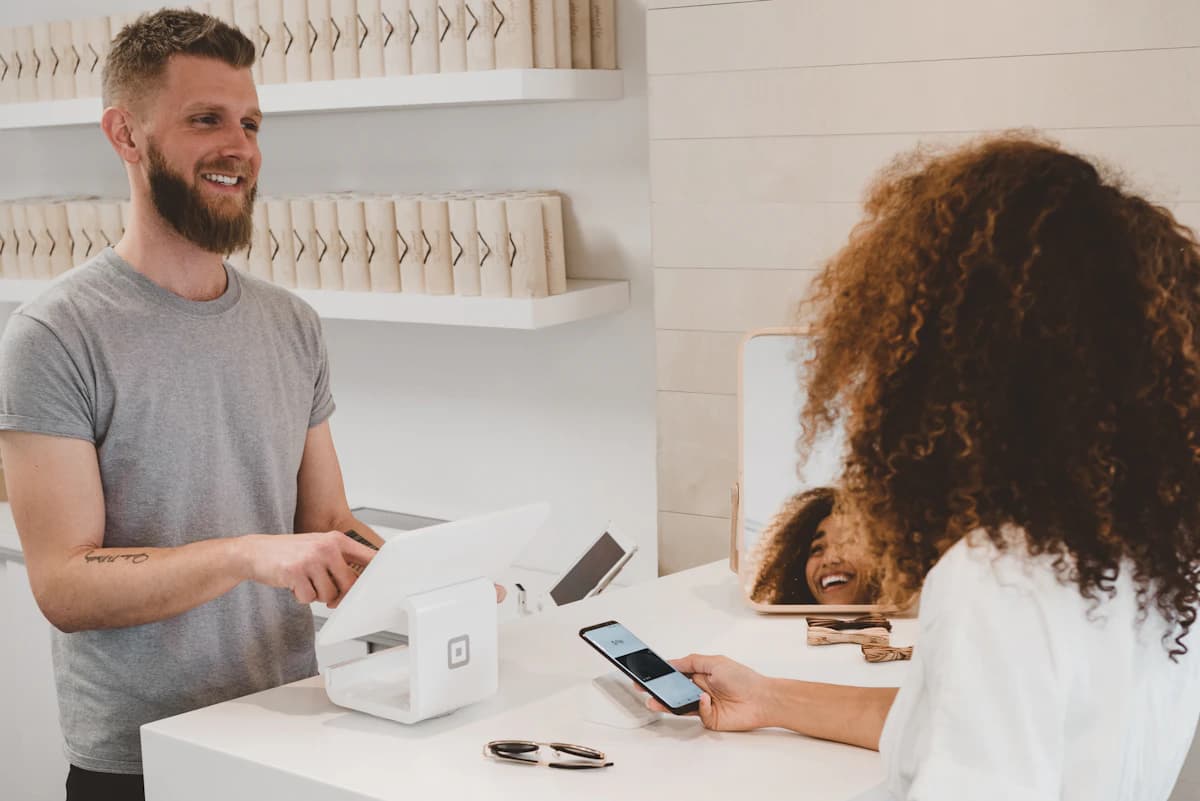
Timing is everything when asking for reviews. The best moment to ask is when a client is looking in the mirror, genuinely happy with their results, and that satisfaction is visible on their face. This is the "mirror moment" — when a client sees themselves and smiles. That's when you ask.
A stylist can say: "I'm so glad you love it! Would you mind sharing that on Google? It really helps us get in front of more people who are looking for exactly what you just got." The client is in peak satisfaction. They haven't left the chair. Their happiness is still fresh. In-person asks at this moment convert at roughly 3x the rate of follow-up texts sent hours later.
Follow up immediately with a text containing the direct Google review link. Don't make them search. Send something like: "Thanks again for trusting [stylist name] today! Here's the link to leave a Google review: [Direct Link]" That one-click access dramatically increases completion rates. Some clients will review right there in the salon while waiting for their next appointment. Others will review on the drive home or later that evening. The point is you've asked at the moment of maximum satisfaction and given them frictionless access to review.
Standard haircut/style template:
"Thanks for coming in! If [stylist name] nailed your cut or style, we'd really appreciate a Google review. [Link]"
Color service template:
"Love your new color! If [stylist name] got the shade perfect, please leave a Google review so other clients can find them. [Link]"
Spa or massage template:
"Hope you're feeling relaxed and refreshed! If [therapist name] gave you a great experience, we'd love your Google review. [Link]"
Premium or specialty service template:
"Thank you for trusting [stylist name] with [service]. Your feedback helps us serve you better and helps other clients discover us. [Google Review Link]"
Use our Review QR Code Generator to create direct Google review links and scannable codes that make the process frictionless. Salons with online booking should include a review button in post-appointment confirmations and receipts.
How Do You Handle Bad Haircuts and Service Complaints?
Not every appointment results in a happy client. Bad haircuts, color mishaps, or unmet expectations happen. Before asking for a public review, protect your reputation by handling complaints privately first.
Invite every client to leave an honest Google review right after their appointment: "Loved your time with [stylist] today? We'd be grateful for a quick Google review! [Link]" Send the same one-tap invitation to everyone — never gate it on how a client rates the visit. Separately, give clients an easy general way to reach the salon manager with any concerns: "Something not quite right? Call or reply anytime — we'd love the chance to make it right." This gives you a path to fix issues, rebook, or offer complimentary corrections without diverting anyone from posting publicly.
For real mistakes (bad color, uneven cut), offer an immediate fix: "We're sorry the color didn't meet expectations. Please come back in [timeframe] and we'll correct it at no charge. We appreciate the opportunity to make it right." Many clients who receive this response will stay loyal and eventually review positively after the correction.
For styling or preference mismatches, the conversation is different: "We notice you weren't thrilled with the cut. What would you prefer next time?" This shows you listen and are invested in their satisfaction, which often converts a neutral experience into loyalty.
How Do You Manage No-Shows and Negative Reviews?
Every salon faces this issue: a client no-shows an appointment (wasting a stylist's time and potential revenue) and then leaves a bad review. It's frustrating because the salon didn't provide poor service — the client simply didn't show up. Yet that one-star review damages your ranking and credibility.
The key is responding professionally without admitting fault or getting defensive. A bad response ("This client never showed up, so they can't possibly leave an honest review") makes you look petty. Instead, acknowledge their frustration and redirect toward resolution.
Template response to a no-show review:
"We appreciate your feedback and are sorry to hear you had a frustrating experience. We noticed you weren't able to make your appointment on [date]. We'd love to make this right and get you booked for a fresh start. Please reach out to us directly at [phone/email] so we can help. We value your business."
This response does several things: it's professional and not accusatory, it acknowledges the issue without accepting blame for their behavior, it shows you're willing to make things right, and it invites them to resolve privately rather than through public reviews. Many clients will reach out after this, and you can often turn them around with a rescheduled appointment or a discount.
For a bad review that stems from a legitimate no-show or cancellation, Google may remove the review if you report it and explain the context. But don't rely on removal. Instead, focus on the response. Potential clients reading that negative review will see your professional, helpful reply and understand the real situation.
For other negative reviews (bad service, stylist rudeness, poor results), the approach is the same: stay professional, show empathy, offer a solution, and invite them to discuss privately. "I'm sorry you didn't have the experience you wanted. We take this seriously and would like to make it right. Please contact [manager name] at [email] to discuss how we can help." This public display of care actually improves your reputation with people reading the reviews.
Implement a no-show prevention system to reduce these situations: send appointment reminders 48 hours and 24 hours before. Offer rescheduling options in the reminder texts. For frequent no-shows, require payment or a deposit at booking. These policies reduce no-shows by 20-30%, which means fewer bad reviews and higher stylist productivity.
How Do You Stand Out Against Competitors and Chains?
Salons compete intensely. Chain salons have corporate marketing and multiple locations. Independent salons compete on quality and personal relationships. Reviews are how you prove that advantage. When someone searches for salons in your area, your 80+ reviews with specific stylist praise will dominate competitors with 10 reviews.
Build review velocity systematically. Request reviews from every satisfied client. Over 12 months of consistent requests, you should accumulate 100+ reviews. This creates a reputation moat. Plus, Google's algorithm favors recent, consistent reviews, so fresh reviews continuously boost your search ranking.
Respond to every review within 24 hours, thanking clients and adding personality. For positive reviews: "Thanks so much! [Stylist] loves creating beautiful work. We can't wait to see you again for [next service]!" For any concerns: "We appreciate your feedback. If there's anything we can do to improve, please reach out directly."
Use the free AI Review Response Generator to reply to reviews quickly and maintain an active, engaged online presence that shows potential clients you care about feedback.
How Do You Integrate Reviews with Your Booking System?
Modern salons use booking software like Square, Mindbody, or Acuity Scheduling. Integrating review collection into your booking workflow makes review requests automatic and perfectly timed.
Post-Appointment Automated Flow: Set up your booking system to automatically send a review request text or email after each appointment. The message is personalized with the stylist's name and service type. A client who just had a color with Mia receives: "Thanks for choosing Mia for your color appointment today! If Mia created the perfect shade, please share a Google review. [Link]"
This automation means you never forget to ask. Every happy client gets a review request. Over a month, if you perform 120 services, you're getting 120 review requests sent automatically. Even a 10% conversion rate means 12 new reviews monthly.
Conditional Routing: Set up your booking system to identify which clients are most likely to review. Perhaps clients who rebook for their next appointment are more engaged and likely to review. Send them review requests first. Or identify clients who have been with you 5+ appointments — they're more invested and more likely to review.
In-App Review Reminders: If you have a salon app or use a booking platform with an app, add a post-appointment prompt that invites every client to leave an honest Google review with one tap: "Loved your visit with [stylist]? Share a quick Google review!" Catching that enthusiasm in-app, right after the appointment, channels it straight to Google for every client.
Loyalty Program Integration: Pair reviews with rewards. "Leave a Google review mentioning your appointment and receive 100 loyalty points toward your next service." This incentivizes reviews while building loyalty. Make sure the incentive is compliant with Google's review policies (it is, as long as you're not paying directly for positive reviews).
Stylist Tracking: Use your booking system to track which stylist's clients leave the most reviews. This creates friendly competition and motivation. Feature your highest-reviewed stylist: "This month's top-reviewed stylist: Mia! Check out the amazing feedback from her clients." This motivates other stylists to encourage their own clients.
What Are Seasonal Trends and How Do You Build a Referral Engine?
Beauty services have clear seasonal patterns. Wedding season (spring/early summer), back-to-school (late summer), holiday parties (December), and post-vacation touch-ups (January after holiday trips) all drive different types of appointments and review opportunities.
Spring Wedding Season (March-May): Brides and wedding parties book bridal hair and makeup. These are high-stakes appointments with happy, grateful clients. Request reviews emphasizing the special occasion: "Thank you for trusting us with your wedding day hair! If we helped you feel beautiful and confident, we'd love a Google review mentioning your experience." Wedding-related reviews are incredibly powerful for attracting other engaged couples.
Summer Vacation and Holiday Glow-Up (June-August): Clients book color, highlights, and cuts before vacations and outdoor events. They're in a positive mindset. Request reviews: "You're about to look amazing on vacation! If we nailed your new look, please share a review so other clients know what's possible."
Back-to-School and Fall Refresh (August-September): Parents and students refresh their looks as the school year starts. Parents often bring children in. Request family-friendly reviews: "We loved getting you and the kids ready for school! Share your experience with a Google review."
Holiday Parties and End-of-Year (October-December): As holidays approach, special event appointments surge. Clients book for parties, photos, and family gatherings. Request festive reviews: "You looked stunning at the holiday party! If our team helped you feel confident and beautiful, we'd love a Google review." Holiday reviews are perfect timing for January New Year's clients researching salons.
Post-Holiday Touch-Ups (January): People often want to refresh their look as a New Year's resolution. New clients frequently come in. Request reviews from new clients: "Welcome to [Salon]! If you had a great first appointment, we'd love a Google review so other new clients know what to expect."
Building a Referral Engine: The ultimate goal is turning reviews into referrals. Happy clients who leave reviews should also refer friends. Create a two-part referral strategy:
First, incentivize reviews with "referral rewards." When a client leaves a Google review, send them a referral code: "Thanks for the review! Here's your referral code [CODE] — give it to a friend and you both get $15 off!" This combines review and referral incentives.
Second, feature referral opportunities in your follow-up messaging. After a client reviews you, send: "Love our work? Refer a friend using code [CODE] and earn rewards. Share your favorite stylist with people who would appreciate great hair too!" Make it easy to refer by providing copy they can text or email.
Create a referral contest: "Our top 3 most-referred stylists this month win a bonus and featured spotlight on Instagram!" This motivates stylists to encourage referrals, which compounds with reviews to create exponential growth.
Over time, your review system becomes a referral engine. Satisfied clients review, reviews attract new clients, and the cycle continues. A salon with 150+ reviews and a strong referral program has a self-sustaining growth machine.
Looking for salon-specific review solutions?
Check out our dedicated BlooTrue for Salon page for widget ideas, pricing, and tips designed specifically for hair salons and spas.
Build Stylist Authority and Attract Premium Clients
BlooTrue shows your Google, Yelp and Facebook reviews on your salon website with one line of code — 100+ widget styles, unlimited views, free to start.
Start Free for Salons and Spas